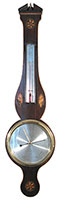
Mercurial barometers were invented in the 1640s, but those made earlier than about 1740 are rare indeed. Most of the ones we sell date from the late 18th to the mid 19th century: they are old enough to be desirable antiques but not so old as to be quite rare and costly.
Our antique barometers are all in working order and in superb condition. Any restoration that has been done has been performed correctly, and the cornices, hands, verniers, thermometers and mercury systems are exactly as they should be for the age and type of barometer. We are happy to deliver the barometers if time and distance allow. Barometers come and go. If you are looking for a specific type, call or e-mail us and we'll put you on our list.
![]()
|
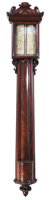
Early 19th century mahogany scientific barometer Another scheme for adjusting, or "zeroing", cistern volume was developed by either Jesse Ramsden or George Adams in about 1770 (there is debate in the journals of the day for credit), using an ivory gauge that incorporated a small plunger which floated from the surface of the mercury in the cistern. The fixed gauge and its movable plunger have an index that can be brought into line by using the "portable screw" in the base of the barometer to push up or lower the leather diaphragm of the boxwood cistern to change the level of the mercury in the cistern, thus keeping cistern volume in step with that of the tube. This system does not adjust for elevation; its intent is just to correct the reading for volume. This barometer was produced by Negretti and Zambra (1850-present day) at their first address of 11 Hatton Garden, London, between 1850 and 1859. The scales are engraved ivory and the fine case is mahogany, with an old and very good finish. The original cistern and ivory float system are still in place, and only the set knob is replaced. There is some minor restoration inside the cistern area, not visible when the cover is in place. The glass tube has a very large bore, common in scientific barometers to reduce the arc of the meniscus, and the tube seems to be original as well. It holds a large volume of mercury. The quality of the case and fittings are very high overall and the condition is excellent. Circa 1850-1859 |
|
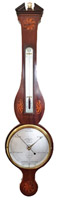
The "Sheraton shell" pattern of decoration in dial barometers, with two inlays of conch shells and two of stylized flowers, was prominent from about 1805 to about 1830 in England. This is a nice example in very good condition, with good color and inlays. The case is outlined with ebony and boxwood stringing and has a recently polished finish. Restoration is minimal, consisting of minor repairs to the stringing. Francis Gally is listed as practicing in Sheffield between 1805 and 1825. This barometer was made 1820-1825. Circa 1820-1825 |
|
Mid
19th century rosewood twin vernier marine barometer with
mother of pearl
Inlaid mother of pearl decoration has been used around the world for centuries, and became very fashionable in English furniture and accessories at about the 1850s. Furniture and wood objects of all kinds were decorated with naturalistic motifs, usually birds and flowers. Barometers too were inlaid with the material, most often on a rosewood or ebonized (black) field. This is a nice example of the art in a marine barometer, veneered with rosewood and inlaid with mother of pearl, brass wire and shaped brass panels. The register and thermometer plates are engraved ivory, in very good condition; clean, clear and readable. The gimbal is a correct replacement for the original, with replaced twin set keys of bone. The finish is old, with a recent clean and wax. The mercury cistern is correct for a marine instrument and old, with a correctly replaced marine mercury tube. There is a very similar marine barometer by William Mowbray in the collection of the Maritime Museum in Kronborg, Denmark. William Mowbray practiced as a clockmaker in the Durham seaport of Hartlepool from at least 1841 to 1871. This barometer is about 1860 in date. With thanks to Mr. David Mowbray for genealogical information on this maker. 37" high |
|
The inlaid conch shell and flower motifs were popular in English dial barometers from about 1805 to 1830. This example was made about 1820-1825 and the silvered brass dial is marked with the maker's name and town. There is some minor replacement in the decorative stringing around the case and the finish has been repolished. The brass finial is a replacement. The de la Torre family (usually listed "della Torre) of instrument makers is recorded throughout England from 1760 to the 20th century. 39" high, 10" wide * |
|
Early 19th Century "Sheraton Shell" inlaid mahogany Circa 1825-1830 |
![]()
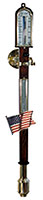
![]() The original condition of the barometer is well preserved - the finish is very old and probably original, being quite worn in places. The case is sound and with minimal evidence of any repair. The ivory scales are all intact and readable with little or no staining. The mercury system has a very old ship's style cistern, possibly an original, and an incorrect replacement mercury tube has now been replaced with a proper marine tube. The brass mounting gimbal is an old reproduction, not the original. Conservation/restoration is limited to cleaning and waxing the case, cleaning the brass and ivory, and replacing the mercury tube. The instrument is fully functional. John Hayden (1808-approx. 1892), born in the US, was a descendant of Scottish immigrants, and spent most of his adult life as owner of a jewelry business in Bath. He married Martha Ann Brown in 1831. Hayden served as a state representative in 1850, 1863, and 1865, and was elected mayor of Bath in 1866. Watches signed by him are known; one is now in the collection of the Maine State Museum. It was not unusual for jewelers to sell "instruments of an optical nature", and a ship's barometer sold in the heart of the ship building area of Maine would certainly be stock in trade for Mr. Hayden. There are probably other clocks, watches, and instruments out there with his name on them, although it is unlikely he actually manufactured any of them. 37.5" high |
|
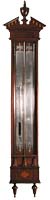
19th
century Dutch inlaid walnut contra-barometer
signed J: Stoppani & Zoon, Amsterdam Spectacular 19th century Dutch
inlaid walnut contra-barometer, so named for one of its two
mercury systems which uses a U-shaped tube with mercury and
colored oil, essentially an expanded scale for easier reading
of small movements. Contra-barometers, also known as bak-barometers (literally,
barometer in a box, for the rectangular glass-fronted case),
are found throughout the Low Countries from about 1740 onwards. Circa 1825-1840 |
|
This is a fine example of a late Georgian stick barometer by a noted London maker. The sweeping scroll cornice, long register plate, stepped cistern cover, and lack of a thermometer point to a date of just around 1800, supported by the fine and simple engraving. The case uses solid ebony mouldings and stringing on the cornice, around the register plate area, and down the front of the case. Figured mahogany veneer sets off the front of the case. Altogether a very elegant and understated example. There are minor restorations to the cornice mouldings and the old finish has been repolished. William and Samuel Jones practiced in the Holborn Hill area of London from about 1787, when their father John died and left them the business, until about 1805, and later in the High Holborn area. They were very technically accomplished, William in his younger years having worked for both Benjamin Martin and George Adams. This instrument was probably made in the 1794-1805 period of their practice. 40 Inches high |
George III period dial barometer by
L Donegan & Co., London.
This early dial barometer
is beautifully made, with the short
shoulders below the cornice and the wide, graceful curve
of the case next to the thermometer box that mark it as Georgian. The
four inlays are of the fan style rather than the later shell
and flowers form, and the case is outlined with checkered
stringing of boxwood and ebony. Sides are crossbanded. The thermometer
plate is graduated in the Fahrenheit scale and decorated
with foliage engraving at the top. The weather
dial is finely engraved with a large compass star in
the center. There is some minor restoration to the
stringing and the finish has been repolished. Circa 1810 |
|
This is a somewhat unusual form of dial barometer, and one which London makers produced in both eight and ten inch sizes. It uses an architectural cornice rather than the more usual scroll or swan neck, and conch shell inlays either side of the thermometer. It is very nicely made with some unusual touches such as the stringing around the thermometer box and has the good and graceful lines of the earlier dial barometers. The dial center is engraved with a handsome compass star. The brass finial and some minor cornice moulding work are the only restorations. The level plate is signed Chs Ganna, 19 Dean St., Holborn. Charles Ganna is not listed in the usual dictionaries of instrument and clock makers, but the work in the barometer is in the same league as the high-quality Somalvico or Dollond workshops at this period. Circa 1815-1820 |
|
Samuel Lainton is well known to barometer collectors for his angle barometers. This stick is in a similar vein, using a large mahogany case with exuberant carving and printed paper register plates. Both case and plates are very original and in excellent condition. The finish is old and well preserved. There are no restorations beyond a cleaning and wax on the finish. Samuel Lainton practiced in Halifax
from approximately 1820 to 1850. Charles Howorth, of the same
city, made nearly identical barometers in the same period.
It is not known who the principal manufacturer of the two was,
and it does not appear that they were in partnership. Circa 1840
|
|
Makers working in England’s
late Georgian Period produced some of the most elegant
barometers of any time. Forms are clean and graceful, and
handsome decorative inlays and stringing were used. This
is one such example made by J M Ronketi. The glazed
door over the silvered
register plate is shaped at the lower edge to
merge smoothly with the slim trunk of the case, and boxwood
and ebony checkered stringing surrounds the door and runs
in a double line down the sides of the trunk. The color
is nicely mellowed to a soft brown. There is an old repair
to the cistern cover, which is original. 38.5“ High, 5.25” Wide (cornice) |
|
A glass plate protects the paper scales, and a manual pointer on a wire slider sets the reading. Ripple moulding decorates the pediment. The mercury system uses a bulb cistern. The scales are Parisian inches, which are 1.066 of an English inch, and divided into twelfths. No maker's name is shown, simply the location KJÖBENHAVN, and the standard weather indications, rendered in Danish:
Circa 1860-1880 |
|
This is one of the first of the “Sheraton Shell” barometers, with the conch shell and flower inlays that were just coming into fashion. It has the late 18th century form of case, with the short shoulders below the cornice, crossbanded sides, checkered stringing, and the wide, graceful curve of the case through the thermometer section. The thermometer plate is graduated in the Fahrenheit scale and decorated with foliage engraving at the top. The weather dial is engraved with the weather indications at the outer perimeter, a convention that changed in the next few years. The finish is old and in very good condition, and there has been some minor restoration to the stringing and the cornice mouldings. Banfield lists Joseph Gafurio as practicing in the city of Chester from 1810 to 1830. Instruments are known signed both Joseph Gafurio, as this one is, and Gafurio and Company. 39" high, 10" wide |
Spencer,
Browning & Co. is one
of the most recognized names in the 19th century production
of instruments in general, and barometers in particular.
This is a good and clean example, with a mahogany case
and brass frames for the register
plates and thermometer.
Register and thermometer plates
are engraved ivory. The
thermometer is graduated in Fahrenheit and centigrade,
with Fever Heat marked at 113 degrees! The gimbal is
an old and correct replacement for the original. The
finish is old, with a recent clean and wax. The brass
frames for the glazing are original and in good condition,
and the ivory plates are in very good condition; clean,
clear and readable. The ivory set knob and mercury thermometer
also appear to be original. The mercury cistern is correct
for a marine instrument and old, with a correctly replaced
marine mercury tube.
William Spencer and Samuel Browning founded the firm known as Spencer & Browning in 1781, and in 1784 were joined by Ebenezer Rust, at which time the company was renamed Spencer, Browning and Rust. They continued under this name until Rust's death in 1840, then again renamed the firm Spencer Browning & Co., and terminated about 1873. This barometer was made about 1840-1850. 37.25" high |
Please contact us if
you're looking for a particular type of barometer.
Or simply Email:
Our Reference Section that
contains photos and descriptions of barometers that have been sold
has been moved HERE. No need to download
photos that don't particularly interest you!
![]()
|
Please,
please, please.... note: |