|
ADMIRAL ROBERT FITZROY
Robert Fitzroy, son of Lord Charles, was born at Ampton
Hall, Suffolk, in 1805 and entered the Navy at the age of 12. During
his long career, he was for many years Captain of the HMS Beagle which
achieved fame as a result of Charles 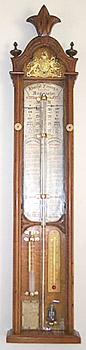 Darwin's expeditions. He eventually
rose to the rank of Admiral, was elected Member of Parliament for Durham
in 1841, and appointed Governor of New Zealand in 1843. Darwin's expeditions. He eventually
rose to the rank of Admiral, was elected Member of Parliament for Durham
in 1841, and appointed Governor of New Zealand in 1843.
 At his retirement from active service in 1850, he
turned his attention to the science of meteorology.
Among his considerable accomplishments, he induced
the Times to print weather information on a daily basis and
the Board of Trade to supply many coastal villages with barometers. He
designed a vastly improved marine barometer. In 1862 he published his
Weather Book which summarized his extensive and immensely important work
on meteorology. At his retirement from active service in 1850, he
turned his attention to the science of meteorology.
Among his considerable accomplishments, he induced
the Times to print weather information on a daily basis and
the Board of Trade to supply many coastal villages with barometers. He
designed a vastly improved marine barometer. In 1862 he published his
Weather Book which summarized his extensive and immensely important work
on meteorology.
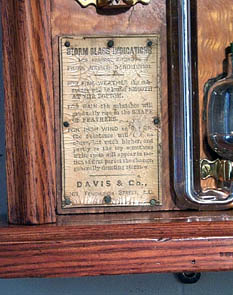
To the barometer collector, he is most remembered for
consolidating weather information and presenting his
now classic Remarks, which distinguish the barometer
carrying his name, that interpret the meaning of rising
or falling mercury.
Admiral Fitzroy's Barometers were not designed by and were probably never
seen by Admiral Fitzroy who took his own life in 1865 before the earliest
known Fitzroys were made.
|
ADMIRAL
FITZROY'S BAROMETER
Charles Edwin Inc.
Copyright © Charles Edwin Inc. 2015 All Rights Reserved