Charles Edwin Inc. - Clocks
Clock Catalog - Longcase, Bracket, Wall, Tower

[ Clocks | Barometers | Instruments | Furniture | Technical | Shows | About Us | Home | Site Map ]

We are pleased to offer these antique clocks. We specialize in longcase or grandfather clocks, bracket clocks, wall clocks, and often have mantel and tower clocks. You may be assured that, as specialists, we have the expertise to judge their quality and worthiness. We personally deliver your longcase clock to you, install it, set it to work, train you in its operation, and provide you with information about its characteristics, operation and maintenance.

Email:

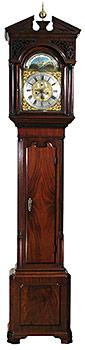
Worswick Lancaster mahogany


Very fine George III Period 'Lancashire Chippendale'
longcase clock by Thomas Worswick, Lancaster

Slim and elegant, this northern English clock has distinctive design features favored by the Gillows cabinetmakers: an architectural pediment with panels of Chippendale-More Informationinspired geometric fretwork, and shaped and dentil mouldings around the hood door. The long shaped door is veneered with sabicu, an exotic hardwood. The eight-day movement strikes hourly, features strike repeating and a lunar mechanism.

8'1" High
Circa 1760-1765
$38,000
No. 1641

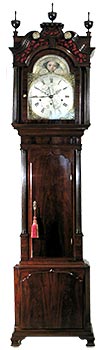
Fearnley three-train


George III Period Northern English quarter-striking
longcase clock by Peter Fearnley, Wigan, Lancashire.

As horologically interesting as it is physically impressive, this mahogany clock has a substantial case that is scaled to support its 14.5-inch brass dial and veryMore Information heavy five-pillar movement. It has three trains-- time, hourly strike, and quarter- strike; a full annual calendar, a sweep-center seconds hand, and lunar works.

8 feet, 5 inches high
Circa 1785-90
$54,000.00
No. 1611


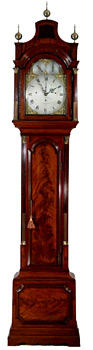
Scottish mahogany longcase


18th Century Scottish Mahogany Longcase Clock
by James Howden, Edinburgh

The slim, elegantly proportioned Edinburgh clock was made with well-figured veneers James Howdenand blind fretwork below the high scrolled pediment. Its clean lines and restrained decoration contrast with the lavishly engraved single-sheet silvered brass dial. The movement runs eight days, striking hourly on one bell unless the silencing mechanism is engaged.

7 Feet, 3 inches high
Circa 1790-1800
$22,000.00
No. 1643


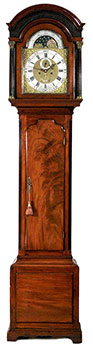
George II oak

George II Period Oak longcase clock with brass dial and lunar dial,
by John Lupton, Altrincham

This sophisticated oak clock has several remarkable features: inlaid compass star patternson on the trunk doorMore Information and base; walnut cross banding on all major panels ; and the domed hood carries a band of fretwork over the arch, pierced to maximize the sound of the hourly striking.

The brass dial has half-hour and half-quarter markings and ringed winding holes that are typical of the pre-1740 period. The lunar mechanism is an engraved and silvered penny moon passing through a circular aperture, with an indicator hand for the day of the lunar month.

7 Feet 1 inch high
Circa 1725-35
$18,500.00
No. 1642

Bullock-t
A fine George III Period mahogany longcase clock
with an early painted dial by Thomas Bullock, Bath

Clocks from Bath in Avon are very nicely proportioned and much influenced by Bristol styles, the two cities being only 13 miles apart. This clock by Thomas Bullock (practiced 1765-1795) is a very clean and original example.

detailssThe mahogany case is veneered in fine flame mahogany; above the dial is the band of complex geometric fretwork and open dentil moulding typical of Georgian clocks from this part of the country. The arch carries the strike-silent lever, a feature retained from earlier brass dials.

Thomas Bullock's four-pillar movement is eight days' duration with rack striking on a single bell.

Circa 1775
7 Feet 9 Inches High
SOLD
No. 1609

Wm Lassell mahogany longcase


George III Period northern English walnut longcase clock by
William Lassell, Toxteth Park, Liverpool

Made in the affluent North, this clock has several features typical of its time and place: More Informationan architectural pediment over the eglomisé panel, book-matched walnut veneers on the shaped trunk door, early use of fluted corner columns, and an elaborately decorated square brass dial. The movement is brass, eight days running, with hourly strike.

Circa 1765
7’ 5½” High
$19,500.00
No. 1580

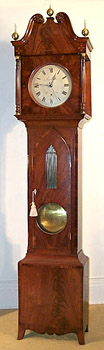
Mahogany longcase


19th Century Scottish Mahogany Longcase Clock
by Robert Bryson, Edinburgh

This is a small, neat Scottish domestic clock, with classical case features of flame mahogany, inlaid boxwood stringing, and fluted pillars on the sides of the case. Its More Informationround white dial is easily read, and the movement runs eight days, striking hourly on one bell.

7 Feet, 1.25 inches high
Circa 1830-1835
$13,000.00
No. 1592


barrow-t


George I Period tortoiseshell japanned longcase clock
by William Barrow of London

Japanning, the practice of imitating far Eastern art in Europe and America, reached a zenith in London clock cases in the second quarter of the 18th century. This clock is decorated in the imitation of tortoiseshell, with a base or ground color of black mottled with red. With the gold and gold leaf designs, the effect is spectacular. detailss


The clock, by William Barrow of London, is eight days duration and is an original combination of case, movement and dial.

Circa 1725-30
8 feet 7 inches high
SOLD
No. 1624

Montrose longcase


Small and attractive Georgian Period Scottish mahogany longcase clock
with a painted dial, by Alexander Miller of Montrose

Georgian clocks from the Eastern half of Scotland, especially Montrose, are often very desirable for their small size, pleasing proportions, and use of inlay for decoration. More InformationThis is a good example of such a clock. Its brass movement runs eight days and strikes hourly.


Circa 1795-1800
7 Feet, 1½ inches high
SOLD
No. 1582

Welsh longcase


Solid mahogany George III Period Welsh longcase clock
signed John Fernhill, Wrexham

A restrained interpretation of the Northern English Lancashire Chippendale form, this More InformationWelsh clock is distinguished by a fine and early painted dial with lunar dial, a mahogany case with reeded corner columns and a raised panel on the base. Eight days going, the clock strikes hourly on one bell.


Circa 1785
7' 4" High
$11,500
No. 1537


Channel Islands mahogany


Regency Period
Channel Islands Regulator.

The Comptoise pinwheel movement runs for about 3 weeks, includes maintaining power, deadbeat escapement, a type of gridiron pendulum, and a center sweep More Informationseconds hand but no calendar and no strike.

Circa 1820
7'7" High
$16,000
No. 775


Bracket Clock by John Snelling
George III Period mahogany bracket clock by
John Snelling, Alton


Very pretty late 18th century English mahogany bell-top bracket clock with a nicely engraved dial. Snelling's five pillar twin-fusee movement features strike/silent and strike repeating, with hourly rack striking on a single bell. It was converted from verge to anchor escapement at some time in its life, in the interests of increased accuracy. The movement's backplate is very nicely engraved, with Snelling's name in a cartouche. The case and movement are otherwise original, with a recently polished finish and a good, warm color.

Circa 1785
20.5" High x 12" Wide x 7.5" Deep
SOLD
No. 1613

Henry Young wall clock

Mahogany Norfolk Wall Clock
by Henry Young, Swaffham

The Norfolk area of southern England produced this form of large, weight-driven wall clocks which were often used in offices and public places.

This particular clock is distinguished from its more More Informationcommon brethren by its engraved silvered brass dial, very fine mahogany case with figured veneers, and two-week duration movement with hourly strike.


Circa 1791-1800
51" High, 21" Wide, 16" Diameter dial
$11,000.00
No. 1546


Tower clock


English turret or "tower" clock movement, with cast iron frame.

The movement was made with Lord Grimthorpe's gravity escapement and uses a double three-legged version.

More Information

Dated 1900
Approx. size is 13" high, 19" long, 18" wide
$7,500.00
No. 772


Please contact us if you're looking for a particular type of clock
or wish to be notified when we update this catalog.


Or simply Email:


Please note:
We regret that we do not have the time to answer individual questions about clocks and barometers not shown here; for help please see the articles in the Technical section.
We also do not offer appraisal or repair services.

Have questions about researching or selling your own clock?
See our Information page.


[ Clocks | Barometers | Instruments | Furniture | Technical | Shows | About Us | Home | Site Map ]